Computable Contracts: What Engineering Teams Need to Know
A technical introduction to Computable Contracts: how they differ from smart contracts, the primitives they expose, and how engineering teams integrate them into existing workflows.
What Are Computable Contracts?
Computable Contracts are the Conduit Network's answer to the limitations of conventional smart contracts. They live at the Primitive Definition Layer (Layer 1) of the Conduit Framework, the layer where Legal Authority, Agreements, and Rights Accounting are specified, and compose those primitives into formally verifiable agreements. Where smart contracts execute arbitrary code on a shared VM, Computable Contracts are anchored to hardware-attested execution at the Trusted Execution Layer.
The key distinction: the legal contract prose and the executable are inseparable. Execution happens inside a FIPS-grade trusted execution environment (TEE), and the result is cryptographically bound to the specific hardware state that produced it.
For Engineering Teams
If your team builds financial infrastructure, settlement systems, or any workload where correctness guarantees matter, Computable Contracts offer:
- Deterministic execution: same inputs always produce the same outputs, verifiably
- Hardware-rooted proofs: execution proofs are tied to FIPS-graded trusted execution environments, not just software
- Composability: contracts can call each other while preserving attestation chains
In practice, your team works directly with the three primitives of the Primitive Definition Layer:
Legal Authority: defines who can instruct the contract and under what conditions, bound to scope, principal, and delegation chain
Agreements: the logic of the contract itself, expressed as verifiable state transitions
Rights Accounting: tracks what each party is entitled to as the contract executes
What's Next
The Computable Contracts stack is rolling out incrementally: rights accounting first, followed by legal authority, with full contract composition to follow. Integration will happen through the Conduit API / SDK: teams will define contracts using the primitives above and deploy to the network without managing appliance infrastructure directly.
Follow along here as each primitive becomes available.
Related Posts
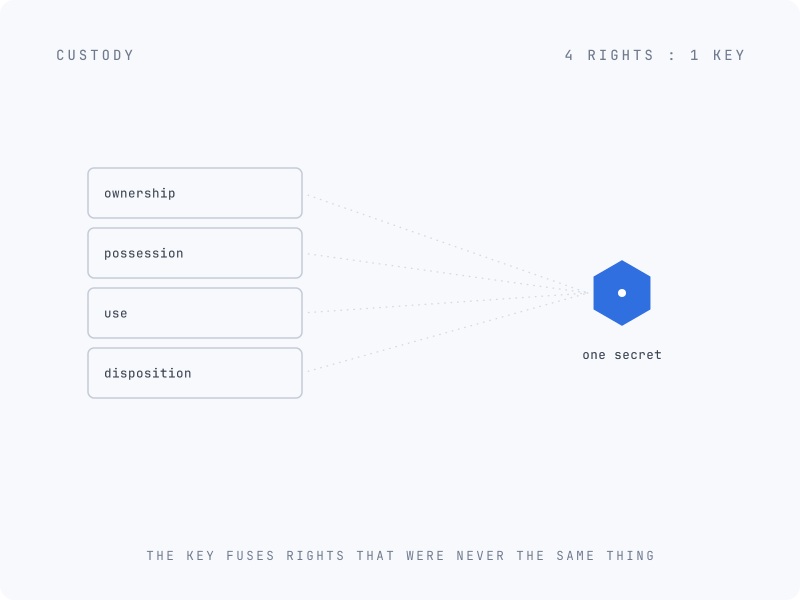
Custody Was Never About the Key
A firmware flaw let attackers guess the keys to thousands of hardware wallets without ever touching them. The people who lost funds did self-custody exactly right. The lesson is not that self-custody is foolish or that custodians are safer. It is that reducing custody to possession of a single secret throws away everything custody is actually made of.
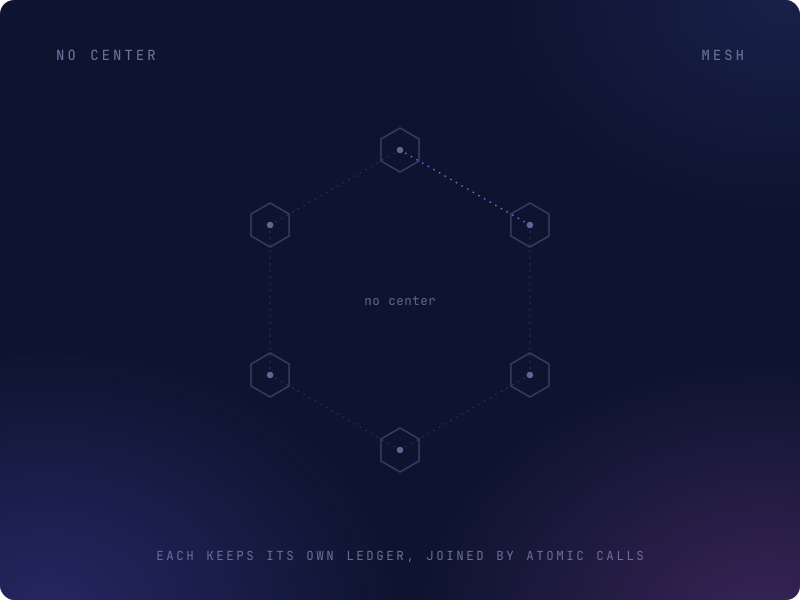
Does the Future of Money Need an Operator? A Third Answer.
Visa says the future of money still needs a trusted operator in the middle. Crypto says it needs global validator consensus instead. Both are answering the wrong question.
Conduit OS: Secure Appliance Infrastructure for the Conduit Network
How Conduit OS delivers a hardened, attestable operating environment for appliance operators, enabling verifiable compute across financial services and public sector deployments.