Does the Future of Money Need an Operator? A Third Answer.
Visa says the future of money still needs a trusted operator in the middle. Crypto says it needs global validator consensus instead. Both are answering the wrong question.
I keep a folder of headlines that all make the same mistake. This week it got a new entry.
Visa, in a piece on PYMNTS, made its case that the future of money still needs an operator. Someone trusted, sitting in the middle, making the guarantees. Read the comments underneath any story like that and you will find the mirror image of the argument: no, the future of money needs no operator at all, just enough validators around the world agreeing on one shared ledger. Two camps, absolutely certain, absolutely opposed.
I have spent enough years in and around this industry to have believed each of them at different times. And I have come to think they are both answering a question that was never the real one.
The real question is not who you trust to run the rail. It is what you have to trust at all.
The operator's bargain
Let me be fair to Visa first, because the operator model earned its place honestly. When you put a competent, regulated institution in the middle of every transaction, you get something valuable: a name to call when things go wrong, a party that is accountable, a set of rules that someone enforces. That is not nothing. For decades it was the only way to move money at scale and sleep at night.
But look at what you are actually buying. You are buying trust in a single intermediary's reputation, its solvency, its uptime, and its willingness to keep serving you. You accept that settlement takes days because reconciliation happens after the fact, in a back office, between systems that were never designed to agree in the moment. You accept that speed and safety pull against each other, so the faster you want to go, the more risk someone has to underwrite.
Concentrating trust in one operator is not a feature. It is a cost. We have just been paying it so long that it looks like the weather.
Consensus does not escape the bargain. It relocates it.
So the other camp says: remove the operator. Let a global network of validators agree on the order of events, and trust the math instead of the man.
I understand the appeal. I have felt it. But watch where the trust actually goes. You are no longer trusting Visa. You are trusting a validator set and the economics that keep it honest. You are trusting that no small group quietly accumulates enough influence to matter, which, if you have looked honestly at the concentration numbers on the major chains, is a harder promise to keep than the marketing suggests.
And you have added new costs the operator model did not have. Every participant on earth has to agree on a single global ordering before anything is final, which is where the latency comes from. Authority and agreement, who is allowed to do this and what exactly was agreed, get pushed up into application code that sits on top of the ledger, which is where the correctness bugs come from. You did not remove the middle. You turned the whole world into the middle and called it decentralization.
That is the pattern in my folder of headlines. Both sides argue about who should be trusted. Neither asks whether the transaction needs that kind of trust in the first place.
The third answer: anchor trust in silicon
Here is the move that took me a long time to see, and it is the reason I do the work I do now at Conduit.
You can put the trust in the hardware.
A transaction can execute inside a trusted execution environment, a sealed region of a real chip, built to a FIPS-graded standard, where the operator of the machine cannot see the workload and cannot alter it. The chip proves, cryptographically, that the correct code ran on protected data. Not a reputation vouching for it. Not a global vote ratifying it after the fact. The silicon itself attests to what happened.
Software-only execution does not clear this bar, and we are honest about that. This is a hardware claim, and it is the whole point. When the substrate can prove its own integrity, "who ran it" stops being the load-bearing question. You are no longer trusting an operator's promise or a validator's incentives. You are trusting a property of physics and cryptography that neither party can quietly override.
Conduit is not a blockchain, and it is not a faster version of the traditional rail. It is a third thing, and it is worth being precise about why.
No center, and no single global ledger
If trust lives in the hardware, you do not need one shared ledger that everyone on earth reconciles against. So we do not have one.
Each counterparty keeps its own privacy-preserving ledger. Those ledgers interconnect through atomic protocol calls rather than through a global log that must be replicated everywhere and agreed on by everyone. The network that results has no center. Resilience, privacy, and trust are not services provided by an operator at the middle. They emerge from many distributed appliances running the same protocol under aligned incentives.
That last part matters more than it sounds. In the operator model, the center is the thing you trust and the thing that can fail you. In the consensus model, the global ledger is the thing you trust and the bottleneck you wait on. Remove both and you are left with something that behaves less like a company and less like a chain, and more like the internet did before we forgot it could be that way.
One operation, not a sequence
There is a second reason the old debate misses. It treats a transaction as a chain of steps to be trusted in sequence: check authority, apply the agreement, move the rights, settle, then reconcile the books. Glue those steps together with after-the-fact reconciliation and you have described exactly why settlement takes days and why disputes turn into forensics.
Collapse that assumption and the picture changes. On Conduit, authority, agreements, and rights accounting commit atomically, as one operation. Settlement and accounting are not separate steps you hope will line up later. They follow as consequences of the one operation that already happened. Economic finality lands in under 100 milliseconds, under real conditions, not as a best case.
When operations execute as one atomic thing inside hardware that proves its own integrity, speed and safety stop being a tradeoff. That sentence is the entire thesis, and it is only possible once you stop arguing about who sits in the middle.
What I would ask now
If you are evaluating the next generation of money infrastructure, I would retire the question everyone is fighting over. Do not ask who operates the rail. Ask what the design forces you to trust.
Ask where authority is proven, and whether it is proven before anything executes or asserted afterward. Ask what has to be reconciled, and when, because every reconciliation step is a gap where risk lives. Ask what happens under adverse conditions, not ideal ones. And ask, plainly, whether the system's guarantees rest on an institution's reputation, a validator set's economics, or something a counterparty cannot quietly override.
I will be the first to say the operator model solved real problems, and that the consensus crowd was right to want the middleman gone. They were running hard at the right instinct and the wrong layer. The future of money does not need a better operator, and it does not need a bigger quorum. It needs trust to become a structural property of the substrate itself.
That is the bet we are making. And it is a very different bet than the one the headlines keep arguing about.
Related Posts
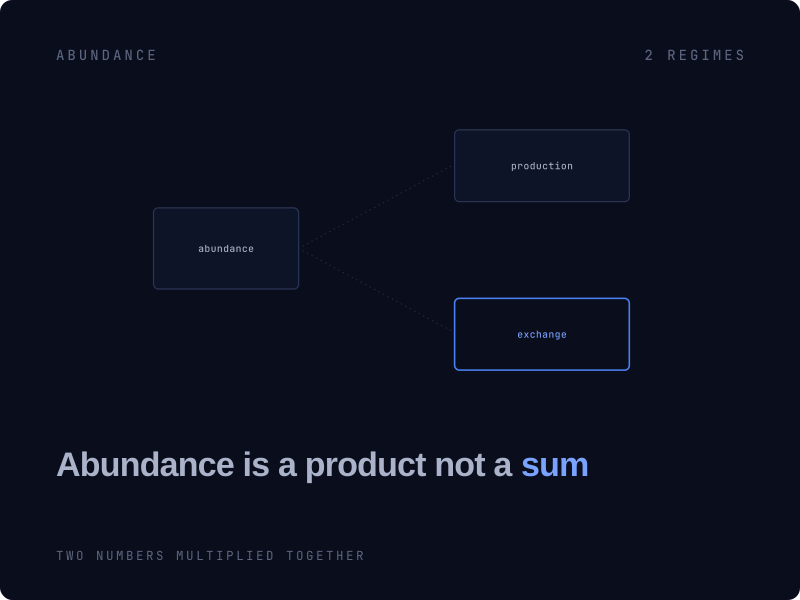
Elon Musk Is Right About Abundance. The Hard Part Is the Other Half.
Musk says AI and robots are bringing an age of abundance where money stops mattering. He's right about production. Exchange is the other half, the one that decides whether abundance arrives.
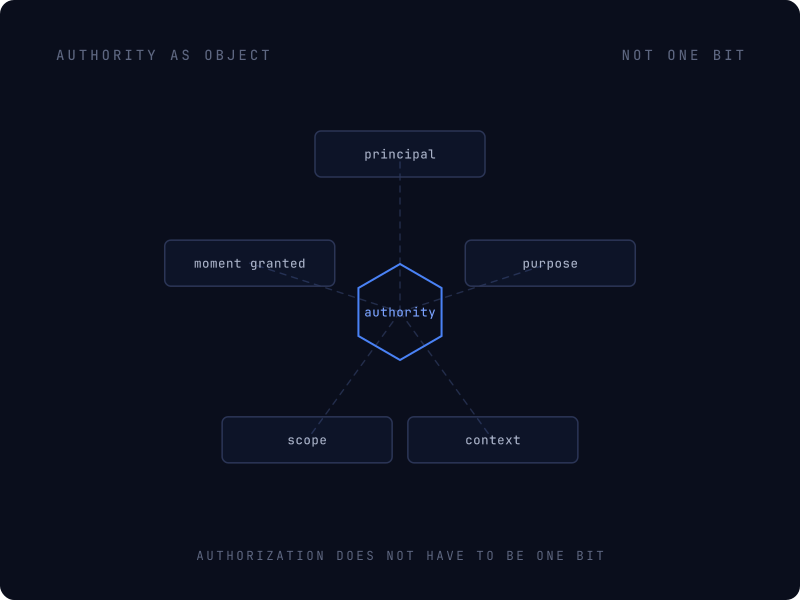
In the Zelle Lawsuit, Everything Turns on One Slippery Word: 'Authorized'
A New York judge just let the state's fraud case against Zelle's operator proceed. Strip away the headlines and the whole fight, and the billion dollars riding on it, comes down to what 'authorized' means when a person is tricked into sending money themselves.
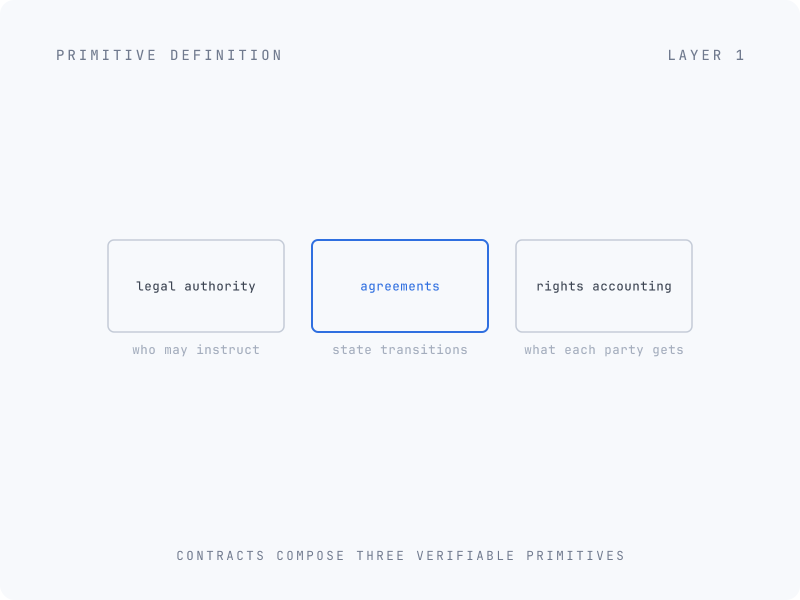
Computable Contracts: What Engineering Teams Need to Know
A technical introduction to Computable Contracts: how they differ from smart contracts, the primitives they expose, and how engineering teams integrate them into existing workflows.