Conduit OS: Secure Appliance Infrastructure for the Conduit Network
How Conduit OS delivers a hardened, attestable operating environment for appliance operators, enabling verifiable compute across financial services and public sector deployments.
Overview
Conduit OS is the hardened operating system layer that runs on every appliance in the Conduit Network, the software at the network's Trusted Execution Layer. Unlike commodity operating systems, Conduit OS is immutable, attested, and purpose-built for high-assurance compute environments.
Why a Custom OS?
General-purpose operating systems introduce unpredictable attack surfaces: kernel vulnerabilities, supply chain risks, and unverified system state. For financial services institutions and public sector operators who require provable compute integrity, this is unacceptable.
Conduit OS addresses this by:
- Booting from a read-only, cryptographically signed image
- Attesting its runtime state through a FIPS-graded trusted execution environment (TEE)
- Exposing a minimal, auditable API surface to workloads
Financial Services
For capital markets and settlement infrastructure, Conduit OS enables:
- Provable execution environments for regulated workloads
- Continuous attestation that satisfies compliance requirements
- Hardware-rooted audit trails for every transaction
Public Sector
Government and defence deployments demand infrastructure that can operate in adversarial environments without compromise. Conduit OS delivers:
- FIPS 140-2 Level 3 cryptographic operations
- Air-gap compatible appliance configurations
- Tamper-evident runtime state
How It Works
- The appliance boots into a signed Conduit OS image verified by the hardware root of trust
- The trusted execution environment attests the OS state to the network
- Workloads are issued only to appliances with valid, current attestations
- Any deviation from the expected state triggers automatic exclusion from the network
Related Posts
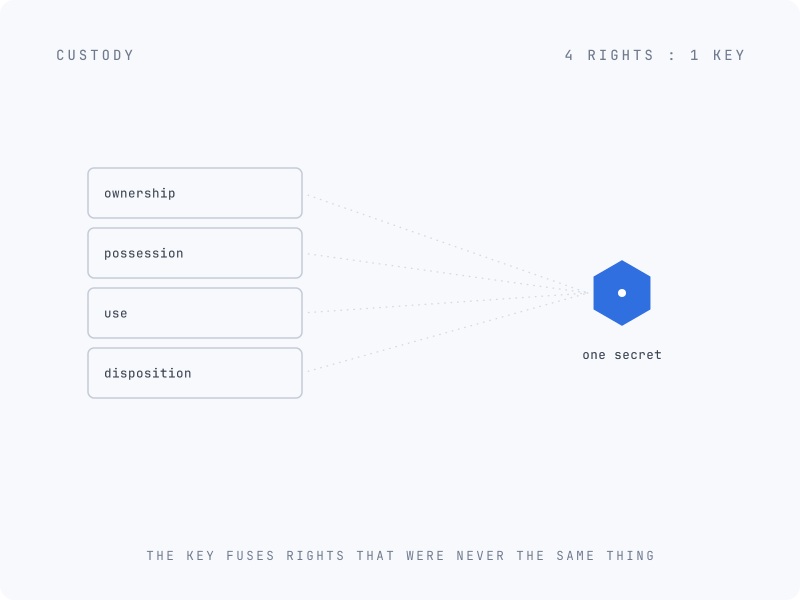
Custody Was Never About the Key
A firmware flaw let attackers guess the keys to thousands of hardware wallets without ever touching them. The people who lost funds did self-custody exactly right. The lesson is not that self-custody is foolish or that custodians are safer. It is that reducing custody to possession of a single secret throws away everything custody is actually made of.
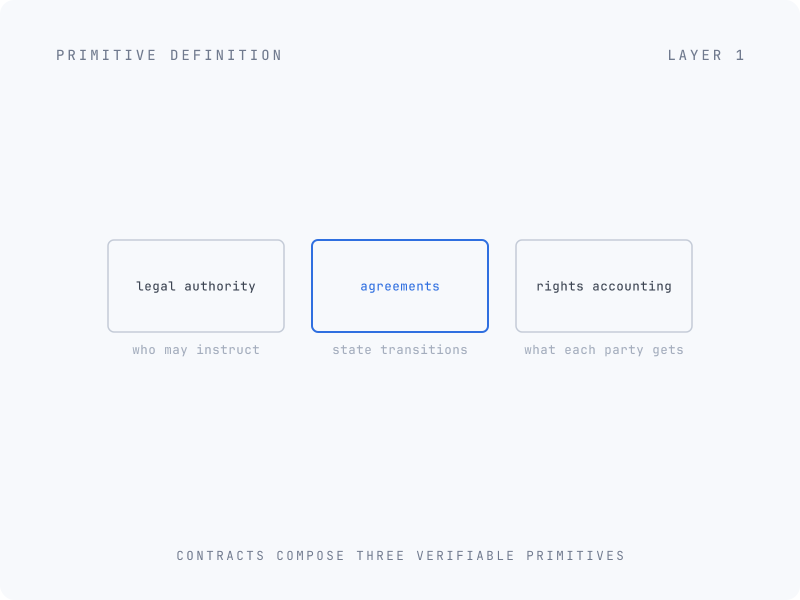
Computable Contracts: What Engineering Teams Need to Know
A technical introduction to Computable Contracts: how they differ from smart contracts, the primitives they expose, and how engineering teams integrate them into existing workflows.
How Cybersecurity Gaps in Layer-One Crypto Networks Threaten Real-World Asset Tokenization
Why the cybersecurity posture of many layer-one networks falls short of enterprise finance standards, and what that gap means for tokenizing real-world assets at scale.